
A Rage of Vision
"He had learned by fire" (332).
Flannery O'Connor's The Violent Bear It Away (1960)
Points for Reflection
The Violent Bear It Away, chps. 5-9
- Of the various roles played by Bishop in this book, which is the most important?
- Why does Rayber continue to parent Bishop instead of institutionalizing him?
- why does Rayber have, not only Bishop as a son, but a hearing impairment and an awkward gait? That is, why might O’Connor allow his life to be so thoroughly inundated with disability issues?
- does the Carmody child’s disability make her pitiable?
- O’Connor weaves Rayber’s memories (when 7 yrs old) about old Tarwater into the message spoken by the Carmodys for Christ (408-15) in an effort to reveal what about Rayber’s motivations in the past, present, and future?
- Rayber has loudly declared that he wants to help young Tarwater become a man (388). Does this project involve giving Tarwater greater latitude than he was given by Old Tarwater? How much freedom does Rayber grant his nephew?
- Does Rayber provide Tarwater refuge when the boy wants it?
- How valid are Rayber’s perceptions, as concerns young Tarwater, the Carmody child, and Bishop?
- Is Rayber’s psychoanalytic diagnosis of Tarwater accurate—his claim that Tarwater is still chained to his dead great-uncle (435), and that the boy is not in control of his own actions but under the sway of unconscious forces (436)? Can he, as he claims, “‘read [Tarwater] like a book’” (438)?
- What “secret truth” about Rayber is Tarwater slowly figuring out?
- When Rayber and young Tarwater confront one another and throw around accusations informed by the Parable of the Sower (Mark 4:1-20), whose claims seem more accurate (448-50)?
- Rayber usually considers his past with old Tarwater a case he has “analysed [. . .] and closed” (408). How accurate is this self-assessment?
- What action does young Tarwater feel compelled to enact and does he, ultimately, succeed in his efforts to restrain himself?
- Does the advice given Tarwater by the disembodied voice merit him his new designation as “friend” instead of “stranger”?
- To what cause can Tarwater’s insatiable hunger be traced?
- What is that “strange waiting silence” that confronts Tarwater (429)?
- Is Tarwater an effective mouthpiece for modernity? Does what he declares about such matters as the unconscious (436), self-reliance (437), compulsion (421, 446, 450), and saving oneself (450-51) accord with twenty-first century common sense?
- Is violence an intrinsic evil in this tale?
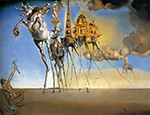
The Temptation of St. Anthony (1946)
oil on canvas
Salvador Dalí
Dr. Paul Marchbanks
pmarchba@calpoly.edu